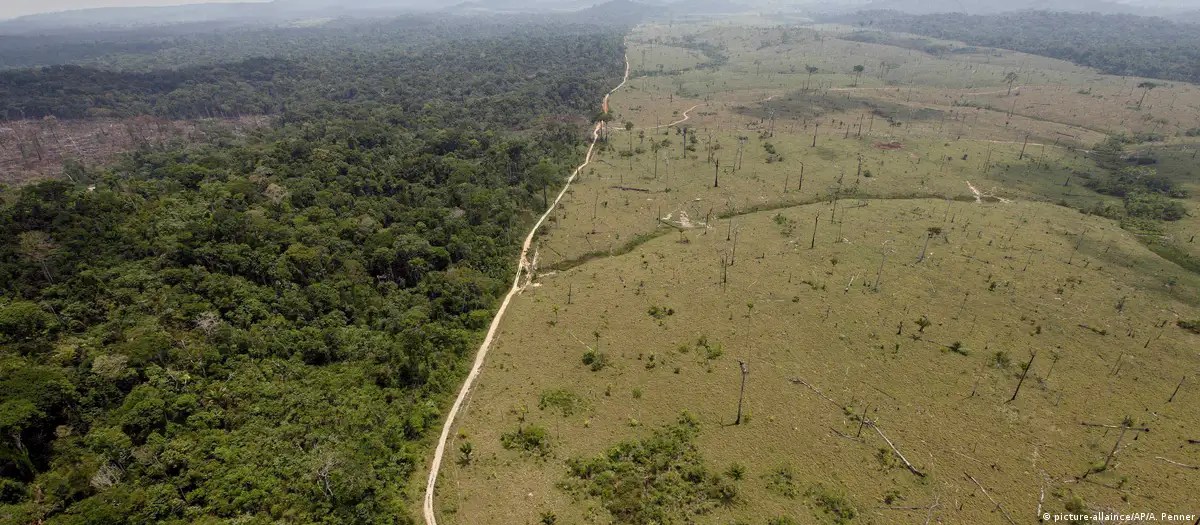
Last November as many of my colleagues and comrades headed to the Brazilian city of Belem at the mouth of the Amazon to fight for climate justice at the United Nations Framework Convention on Climate Change – UNCOP30 – I spent a week in Brazil’s Cerrado region, in a little-trafficked corner of Bahia state. Not much of a tourist destination, the Cerrado is a huge area the size of Western Europe which in recent decades has earned a sobering nickname: the Kingdom of Soy. I was there to deliver a report to local community leaders illuminating the role of a major U.S. pension fund manager in buying up land that, local agrarian communities believed, rightly belonged to them. The latest in a series of reports on landgrabs in the Cerrado researched and published in Portuguese by the Brazilian Network for Social Justice and Human Rights and adapted in English by my organization, Friends of the Earth U.S., this was our first report to focus on western Bahia – one of the regions in Brazil with the fastest growing industrial soy plantations, and consequently a hotspot for accelerating deforestation.
*
Arriving by plane to Barreiras, an agribusiness hub of fertilizer companies, feed stores, and tractor supply outlets, I was welcomed by a warm-spirited, energetic man named Abner, who runs logistics for 10envolvimento, a local NGO. The organization had grown out of the Catholic Church to help agrarian communities gain collective title to their lands. Over the next few days, Abner explained, we would drive through the basins of the Rio Grande, the Corrente and the Carinhanha rivers and meet with spokespeople for traditional communities who’d been expelled from the plateaus to the lowland valleys. We’d be traveling entirely within the bounds of the area known as “the ring of soy.”
The topography here is wide expanses of flat scrubland punctuated by sudden plateaus called chapadas, not unlike the rolling hill country of West Texas, dressed in a green chaparral vegetation, spindly low trees, buriti palms, euphorbia, cactus. Though its home to some 5% of the world’s species, the Cerrado is not overwhelmingly dense with life like a rainforest or striking to the eye like the cathedral redwoods of California. But it teems with biodiversity: 12,000 plant species, over 800 tree species, about the same number of distinct types of birds, and mammals found nowhere else on earth: maned wolves, giant anteaters, agoutis and the onca-pintada, the largest jaguar in the Americas. But in this whole vast expanse, Abner explained, the explosive growth of monoculture plantations had confined the remaining native Cerrado vegetation to the protected river valleys and lowlands – the same areas occupied by the remaining traditional communities.
Projecting a map on the wall, Abner pointed out dark streaks of green amidst wide fields of brown: “These are the river valleys where the communities remain,” he explained.
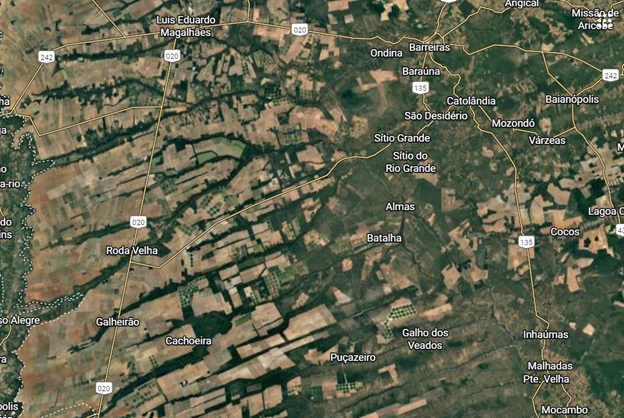
The tan areas are industrial farms; note the dark green river valleys running east-west amidst the cleared land. This is where native vegetation and traditional communities manage to remain.
Before much of the Cerrado became a global provider of cotton, soy and other industrial crops it was known by ecologists as Brazil’s “birthplace of waters” for its critical role in feeding the nation’s rivers. Underneath the land here is a vast subterranean reservoir, the Urucuia Aquifer. When agronomists and hydrologists came – “from your country, from Nebraska,” Abner pointed out wryly – “they judged that the Urucuia could never be depleted.” So the companies they worked for set about drilling wells 500 meters deep and installing massive center-pivot irrigation systems.
“Now,” said Abner, “the whole basin is drying up.”
A comprehensive geological survey published in 2023 showed that the aquifer underlying much of the Cerrado is being depleted faster than it can recover. The São Francisco river which forms here before crossing 505 municipalities in six states, no longer reaches the Atlantic.
Since 2021 the Urucuia has lost a volume of water equal to seven-and-a-half cubic miles – far more than it can recharge. The clear cause is industrial irrigation, combined with rapid deforestation. In the last 40 years, more than half of the Cerrado has been plowed under and converted into industrial plantations. But local communities don’t need geological surveys to tell them what’s happening – everyone I would speak to in the coming days repeated what they lived everyday: our streams are dry, our cattle are thin, our Cerrado is losing its life.
*
In 2024 when a UK-based group called Earthsight came to investigate cotton production, Abner gathered water samples from a tributary of the Rio de Janeiro that courses through an ecological preserve. All eight samples found high levels of atrazine and glyphosate. The Earthsight report, Fashion Crimes, traced cotton from western Bahia’s industrial estates through the sweatshops of Asia to fast fashion brands H&M and Zara: vast stretches of Cerrado vegetation wiped out for global fashion.
Earthsight’s approach was similar to what I was doing here, only instead of following the flow of cotton, I was following the flow of money – specifically, looking at the role of one U.S.-based financial firm in buying up tracts of land and dedicating it to industrial crop production.
The retirement fund manager TIAA manages $1.3 trillion for academics, non-profits, and knowledge professionals and is one of the largest investors in fossil fuels and agribusiness, with an estimated $33 billion invested across both sectors. TIAA’s subsidiary Nuveen Natural Capital is a land-focused asset manager which has bought up over 3 million acres of land across 10 countries, making it the seventh largest institutional farmland owner in the world. Its land portfolio in Brazil, where it owns or manages over 1 million acres, holds some of its most contentious acquisitions.
Years of scrutiny by researchers and journalists have alleged that TIAA, through its Brazilian subsidiary Radar and a joint venture with Brazil’s largest sugar company, Cosan, has bought multiple properties through a complex corporate structure. Some of its properties appear to have been purchased from sellers who had acquired the lands illegally; legal inquiries have examined whether the firm, which is based in New York, bypassed laws limiting foreign ownership of Brazilian farmland. TIAA has thoroughly rejected this claim and all other claims of wrongdoing: “In August 2025, the technical division of INCRA — the National Institute of Colonization and Agrarian Reform in Brazil — conducted a detailed review of Radar’s corporate control structure and issued a formal decision confirming its legality, expressly recognizing that the company is under Brazilian control and not subject to foreign ownership restrictions under Brazilian law,” a Nuveen representative told me in an email.
In a region dominated by agribusiness behemoths like Cargill, Bunge, ADM, SLC Agricola, TIAA is far from the largest or most problematic corporate actor. But as a company whose main business is managing retirement funds, TIAA presents a unique case that illuminates the problems generated when financial firms treat land as an investment asset.
In 2022, nearly 300 TIAA clients filed a formal complaint with the UN-sponsored Principles for Responsible Investment (PRI) initiative, in which TIAA is a prominent member. The complaint alleged that its substantial investments in fossil fuels and deforestation violate TIAA’s climate pledges and commitment to the body’s six Principles for Responsible Investment. The complaint was dismissed, but the attention it brought, along with over a dozen faculty senate resolutions at U.S. universities calling on TIAA to divest from dirty enterprises, have likely played a role in TIAA’s increasing efforts to demonstrate social responsibility. The firm’s publicity materials show a proud commitment to making farmland ownership sustainable: “We believe that our farmland investments can help to meet global demand for food, while encouraging sustainable practices to be good stewards of the environment over the long term.”
This year Brazil will export 110 million tons of soybeans, mostly to China. Some 90 percent of the soy grown in the Cerrado goes there, likely including soy grown by SLC Agricola which regularly leases TIAA’s properties. Contrary to what you might think, this massive flow of soy is not for tofu and soy sauce, but to feed pigs in China’s industrial feed lots. This is the global demand for food that TIAA is helping meet – and it drives some of the most destructive land use practices on Earth.
Decades of attempts to halt the expansion of the soy industry have been largely a one-step-forward-two-steps back affair. A case in point is the Amazon Soy Moratorium – an agreement forged two decades ago between environmental groups, Brazilian authorities, agribusiness and western consumer goods companies to refrain from purchasing soy grown on land in the Amazon that was deforested after 2006. The result has been hailed as one of the most effective environmental achievements of recent decades: researchers estimate that an area of rainforest the size of Ireland would have been lost to soy farms in Brazil without the moratorium and related conservation efforts.
Nonetheless, the agreement had one unfortunate side effect: the companies that had been wiping out the Amazon for soy simply moved next door, as it were, and effectively turned the Cerrado into a sacrifice zone. By 2024, after twenty years of global investment in the Kingdom of Soy, the deforestation rate in the Cerrado had surpassed that in the Amazon.
Curiously, it was shortly after the 2006 Amazon Soy Moratorium went into effect that global financiers began eyeing land in the Cerrado. After the 2008 financial crisis and the resulting collapse of the U.S. housing market, TIAA, along with many other financial corporations, needed a secure place to park their funds, and they identified farmland as a sound investment. With the soy industry pushing into the Cerrado, land values increased; financial firms saw the trend and began investing. The more land was bought by foreign firms, the higher the prices went. The resulting boom in rural real estate in turn stimulated business deals between investors like Nuveen Natural Capital (TIAA’s land acquisition arm) and the Harvard Management Company and major agribusiness interests like SLC Agricola, Cosan and Bunge. Growth begets growth, business feeds business, and soon enough, there was almost no Cerrado left for the people who had scratched out a livelihood here for centuries.
To make matters worse, while the threats to the Cerrado continue unabated, the Amazon Soy Moratorium itself has now been successfully dismantled by Brazil’s powerful agribusiness lobby, with leading global soy traders abandoning it in droves.
*
From Barreiras we spent a day driving around the ring of soy. Near an industrial crossroads called Luis Eduardo Magalheas we drove a long dirt road alongside properties called Bananal Farm and Rio de Janeiro Farm, partly owned by TIAA. What I saw was industrial farm after industrial farm, all brown, barren and dry: no people, no animals, no crops, no life. As in much of the U.S. heartland, the word “farm” is deceptive: the Rio de Janeiro Farm, for example, covers roughly 67 square miles – the size of Washington D.C. In November the view was especially bleak: usually, I was told, the rain would have started by now. At any other time of year the landscape might be greener, lush with soy and cotton. But, for the industrial plantations as for the peasant farmers, planting had been delayed due to drought.
We traveled several hours south to Correntina – a lively little city with the beautiful Corrente River flowing right through the center of town – and then down long dusty roads to meet with peasant farmers whose land abutted one of TIAA’s legal reserves, a place called Fazenda Felicidade.
A wiry man named Dernavaldo walked me along the barbed wire fence that, he said, divided TIAA’s legal reserve from lands still in the hands of the local communities.
“Our territory was much larger in the time of our ancestors,” Dernevaldo explained. “Our grandparents, great-grandparents, great-great-grandparents – they pastured their animals all the way to the border of Goiás; that was all the territory of our people. With the arrival of agribusiness, what’s left for us is just a small piece. What’s left of the Cerrado in Correntina is just 3 percent. And in those 3 percent, this area of ours is being illegally seized by companies we’ve never heard of. They simply arrive, start building fences, start deforesting, and expelling us. It’s the law of the strong expelling the weak, right? And so we are in this situation, suffering, facing gunmen, heavily armed people in the service of these farms, these companies.”
Though his words reflected a harsh reality, Dernevaldo was clearly a man in love with the land.
“Pastoralism is native here in the Cerrado. We want the Cerrado the way it is, with the native vegetation, the animals grazing on this grass. We didn’t plant it here. We don’t want to clear the land to plant grass; that’s not what we’re interested in. Our interest here is to see a pequi tree like this one, flowering, producing fruit for our family, and for other people who come here to pick the fruit and eat it. These are natural fruits; nature produces them for everyone. So we don’t have any interest here in income, profit, selling, or making money. What we defend here are our customs and traditions.”
“We are also descendants of Black and Indigenous people, so our people have the tradition of collecting roots of medicinal plants for both people and animals. We are children of this land, we are native to this place, we know how to do things here. If they take us away from here, if they dry up our river, where will we go? We have nowhere to go. We’ll have to go live under a bridge. Is that what the government wants? Is that what the big businessmen, the people with money, most of whom are here illegally occupying these territories, buying or illegally seizing land and selling it in bad faith to others – this commercialization they’re doing – is that what they want? They can go somewhere else, but where will we, the natives of this place, go? We are family farmers, small farmers, and we have this great role in society of producing healthy, natural food to put on the table of all Brazilians. So this is a huge loss for us.”
As we talked, I reflected on my own role here, publishing report after report documenting in great detail the ways in which financial speculation and the expansion of the soy industry are driving land grabbing and deforestation. But Dernavaldo’s words, and the looks on his face as we walked the dry Cerrado scrub, tell the story in ways no set of data points can match.
When the time came to part, I had one more question.
“Your cattle,” I said, “They feed off the native vegetation?”
“Yes.”
“It’s true what I was told, that you keep about one cow for every ten hectares of land?”
“In the best of times, yes.”
“You sell the meat, or eat it?”
“Some we sell, but mostly we eat it. It’s what keeps us alive,” Dernevaldo said.
“Does the meat taste better than cows that eat grass?” I asked.
Dernevaldo’s smile cracked into an easy laugh. “Come on! There’s no comparison.”
*
Dernevaldo belongs to a traditional agrarian culture little known beyond the Cerrado. Descended from Indigenous people, enslaved Africans and Portuguese settlers who’ve been here for centuries, they refer to themselves as “Fundo e fecho de pasto” communities. The term refers to two complementary models of collective land management. In the fechos de pasto, or pasture farms, animals are grazed on fixed communal lands. In the fundos, families with small landholdings herd their cattle across distant pastures. What they share – and what they are struggling to maintain – is a way of life that depends on the common use of the open rangelands of the native Cerrado. The fundo e fecho de pasto system, as Dernevaldo confirmed for me, allows for roughly one cow per ten hectares of land, moved around the landscape by the fecheros, much like old school cowboys in the U.S. west. When there’s enough land and enough wild vegetation to sustain open grazing, the Cerrado recovers quickly. But the encroachment of the big farms has fenced off the vast flatlands and confined the fecheros and their cattle to ever-diminishing plots.
It’s not just the industrial farms that have hemmed in these agrarian communities; ironically it’s also the environmental laws the industrial landowners are expected to adhere to. Since 1965 Brazil has maintained a set of environmental regulations known as the “codigo forestal,” the forest code. Under the law, every rural property needs to maintain a portion of its land in native vegetation. In the Amazon, or what’s known as “the legal Amazon,” the portion is 50 percent; in the Cerrado, it’s 20 to 35 percent.
The code also includes specific rules for Areas of Permanent Protection, such as riverbanks and slopes, which are to be left undeveloped regardless of the legal reserve percentage. In western Bahia most of the lowlands have become designated legal reserves for the big farms.
“While the intention may be positive,” Abner told me,“the effect was to create digital fences that separate communities from the areas where they traditionally graze their cattle.”
And there are further complications: initially, the legal reserves had to be on the same property that was under development. But under agribusiness pressure, the forest code was amended to license remote properties as legal reserve as long as they’re in the same biome. Topographically, the result is huge areas entirely cleared for monoculture, with small patches of native Cerrado fenced off as legal reserve for agribusiness. At the human level, the result is that the fundo e fecho de pasto communities – people who’ve lived here for centuries, arguably with a positive impact on the land – have nowhere left to live.
*
As we drove back to Correntina over dry arroyos and past vast plantations, it occurred to me that understanding the dynamics of the Cerrado is less about what you do see than what you don’t see. Ecologists refer to the Cerrado’s abundant but markedly uncharismatic vegetation as “the upside-down forest,” because, unlike Brazil’s neighboring Amazon and Atlantic rainforests, up to 70 percent of the Cerrado’s biomass is found in the extensive root systems that allow for survival in the long dry seasons and frequent natural fires. Porous limestone substrate and sandy soils allow water to penetrate quickly, filling the aquifer, feeding the deep roots – but leaving the land with a dry, parched desert-like quality.
Similarly, when it comes to land grabbing and the displacement of traditional communities: when entire populations are marginalized – literally, shoved to the margins – they become invisible. You drive through their territories and what do you see? Farms, and farms and farms – and nothing of what came before. The British journalist George Monbiot whose book Regenesis cites the Cerrado as a place where ecosystem destruction has occurred “on an unimaginable scale,” observed, “The farms look more like sea than land: gigantic fields unmarked by any feature, stretch to the horizon. The remnant pockets of life resemble islands in the ocean of destruction.”
Monbiot’s islands are precisely the places occupied by the fecho e fundo de pasto communities.
*
In Correntina I attended a public hearing where over 150 community representatives would address local authorities, including the environmental ministry and the office of the state Governor. In an auditorium packed with peasant farmers, advocates and authorities, the fundo e fecho de pasto representatives would make the case that their rights to land and livelihood were under fundamental and continuous attack.
Shortly after 8 a.m. a man named Eldo Moreiro Borreto set the stage: “Our goal,” he began, “is to balance our livelihoods with the preservation of the Cerrado. We begin with history because if we forget our history, we disappear. From the beginning, 300 years ago when our pioneers came here, our struggle has been to find a way of life in harmony with the maned wolf, the once-pintada, the water.”
“In the 1970’s we had 100 percent of the territory. Today we’ve been pushed into small pockets of the lowlands. Today, 97 percent of the land in Correntina is subject to illegal deforestation, legal deforestation, violence, people disappeared. Our choice is to fight or disappear.”
“We want to do what we know best,” he continued, “to take care of the springs, the birds, all of nature. We are trying to hold onto the 3 percent of the land we still have. We know we can help the Cerrado recover, but with only 3 percent of the land, we can’t make enough of a difference.”
Eldo turned to look directly at the Governor’s Chief of Staff: “We need you to initiate a review of land licenses to show where agribusiness lands encroach on fundo e fecho de pasto lands, and to expose and denounce environmental crimes.”
The officials nodded.
The next man up, who asked that his name not be published, also spoke directly to the Governor’s Chief of Staff. “If you’d like to hear about environmental crimes, just yesterday we were moving our cattle and we were stopped by a group of armed men. One of us was put in a private jail for five hours. Our truck was taken and kept by the landgrabbers. We need you to help us. What are you going to do?”
The Governor’s Chief of Staff promised to talk with local law enforcement. But he was clear about the circumstances: “The big companies have too much power in the legislature, in the judiciary,” he said. “This makes it difficult to resolve these problems. All we can do is listen to you, look you in the eyes, and try to resolve them using civil law. But we’re flooded with complaints. On my desk right now I have two thousand complaints. We can’t get to them all,” he said. “In the end we can only do what we can do.”
After the hearing, while the organizers circled up with the Governor’s staff, a small wiry man in a colorful cowboy shirt approached me and introduced himself as Carrininho: “Little Sweetheart.” Carrininho was from a fecho de pasto community called Gado Bravo – Brave Cattle. Entirely unprompted, Carrininho let loose: “I want to tell the consumers in the U.S., when they eat meat raised on Brazilian soy, it’s stained with the blood of workers and communities that have been massacred by big capital. You’ve heard of blood diamonds?” he said. “This is blood soy.”
*
What Carrininho called blood soy – a humble, protein packed bean so valuable as a global food commodity that major multinationals have proven willing to wipe out entire ecosystems in order to plant it – thrives at scale in massive open spaces like the Great Plains of the U.S. Midwest and the rolling savannahs of the Cerrado. In Brazil, where land governance is freighted with historic conflict, acquiring the acreage needed to meet market demand is messy, to say the least – which is why TIAA’s role in land acquisitions has touched a nerve there.
Several months before my visit, as I was editing our report on land acquisitions in western Bahia, a spokesperson from TIAA told me in an email that they had not acquired any new lands in the region since 2019. The email explained that the company’s decision to halt land acquisitions in the region had been made “for diverse commercial reasons.”
Under pressure from campaigns led by Friends of the Earth and our allies, the firm had adopted a “No Deforestation” policy in 2018, which committed it stop buying any land in the Cerrado that had been deforested after 2009. This, along with the alleged links to public land grabbing scandals and legal challenges to their land acquisitions, likely constrained their ability to invest in the region. And, given that land values in the region have doubled since 2020, while the region is effectively drying up and becoming less viable for farming in the long run, the financial risks may be too high, and the allure worn off. For those who see land speculation as an inherent evil, this is something of a relief. But with the AI stock market bubble set to burst at a scale that could dwarf the 2008 crisis, and with companies and financial firms abandoning their Environmental, Social and Governance commitments en masse, it could be just a matter of time before the rest of the Cerrado’s land gets turned into portfolio assets for Wall Street traders, forests and financial risks be damned.
When they buy land as a speculative asset, the fund managers at TIAA/Nuveen and Harvard are not deploying a unique insight. Over a century ago Mark Twain offered the cheeky investment advice “Buy land, they’re not making it anymore.” And every peasant farmer knows that land is wealth. Conversely, redistributing land ownership has historically been one of the most direct ways to reduce social and economic inequality. For people whose livelihoods and culture depend on the land, secure land rights are essential, allowing farmers to take out loans, invest in resilient practices, and build a secure future. Agrarian reform – the mass redistribution of land to empower rural production – was the basis of every revolutionary movement of the twentieth century, from reconstruction in the U.S. south to the egalitarian gains of the Mexican revolution. Indeed, Brazil’s own 1988 Constitution required the government to “expropriate for the purpose of agrarian reform, rural property that is not performing its social function.” Unfortunately, the “social function” mentioned there was not well defined, and, just as happened in most of the western hemisphere – indeed, in most of the world – Brazil’s Land Reform National Plan never was put into action.
At a time of jaw-dropping economic inequality, agrarian reform seems a dream of a bygone progressive era – and yet a clear-eyed understanding of the role that responsible land stewardship plays is central not just to social equality, but to confronting the ecological crisis.
Globally, land is under unprecedented pressure – not only for extracting wealth in the form of minerals, calories, infrastructure and habitation, but also, as the case of Brazil’s legal reserves illustrates, for its environmental benefits. The 2025 Land Gap report, published biannually by a collective of academic and independent researchers, recently assessed the land area required for carbon removal in climate pledges submitted to the UN Framework Convention on Climate Change and came to a troubling conclusion: the amount of land that governments have pledged to devote to climate mitigation exceeds 1 billion hectares – an area larger than China, and far beyond what is feasible or even imaginable.
Already, over half of Earth’s land surface has crossed critical ecological thresholds, devastating ecosystems, threatening human rights, undermining food production and destabilizing economies. Add to this the pressure on land from carbon removals – meaning closing off land from access or development, massive afforestation, carbon-capture and storage, and other largely unproven climate mitigation approaches – and you have a fever dream of global terraforming as likely to succeed as the tech oligarchs’ perverse fantasy of colonizing Mars.
Through sophisticated data crunching, the authors of the Land Gap report came to the same conclusion that the fundo y fecho y pasto communities reach in their daily experience: what is needed is equitable and sustainable land-use policies that integrate social, biodiversity and climate mitigation goals and are based firmly in the rights, the needs, and the interests of local communities.
*
The day I flew homewards from the Cerrado, the Brazilian government made a landmark announcement at the UN climate summit: it would demarcate 10 new Indigenous lands, expanding Brazil’s legally protected Indigenous territories to 117 million hectares or approximately 13.8% of the country’s territory. That same week another significant promise was made when 15 countries, including Brazil, Colombia, Costa Rica, Ecuador, Fiji, Indonesia, and the Democratic Republic of the Congo, pledged to recognize and protect 160 million hectares of Indigenous, Afro-descendant, and local community lands by 2030. The commitment was accompanied by the expansion of the Forest and Land Tenure Pledge with $1.8 billion in funding for community-led conservation and policy reform. Together, these pledges not only offer a concrete solution to the global problem of land inequity, but they serve to underscore the central role of secure land rights in managing the climate crisis.
But these pledges, inspiring as they may be, land in a political context marked by an impossible power asymmetry. The amount of finance going to socially and environmentally responsible practices is dwarfed by the money driving destruction. The political landscape of the UN climate summit itself was shaped by the presence of 300 agribusiness lobbyists which dwarfed many national delegations. As author and food systems scholar Raj Patel wrote on LinkedIn at the time, “the Lula administration’s inability—and unwillingness—to confront its meat traders, soy barons, and fertilizer giants had already set the terms. Food systems generate a third of global greenhouse gas emissions. Negotiating climate solutions without addressing food is to have abandoned good faith and scientific wisdom.” Indeed, in the months before COP30, Brazil’s Congress—dominated by agribusiness interests—rammed through the “Devastation Bill,” which will gut environmental licensing and likely undo any gains from COP30.
It’s this political and economic landscape that will determine the fate of forgotten communities like Fazenda Felicidade and Gado Bravo in the dry gullies of western Bahia. Foreign finance firms like TIAA may paint themselves responsible, but it’s the power asymmetry between the peasant farmers and the financial interests behind big agribusiness that sets the terms. Maybe some of the harm can be mitigated by corporate social responsibility; continuing pressure on private companies to adopt policies like TIAA’s No Deforestation policy can certainly help by shifting their business incentives. And we have to hope to that high-level commitments like the Forest and Land Tenure Pledge can help stem the tide of the land speculators and agribusiness barons. But in today’s political climate it’s tough to see how anything besides a massive shift in who wields power can confront what Dernevaldo cited as that most enduring of natural laws – the law of the strong expelling the weak.

