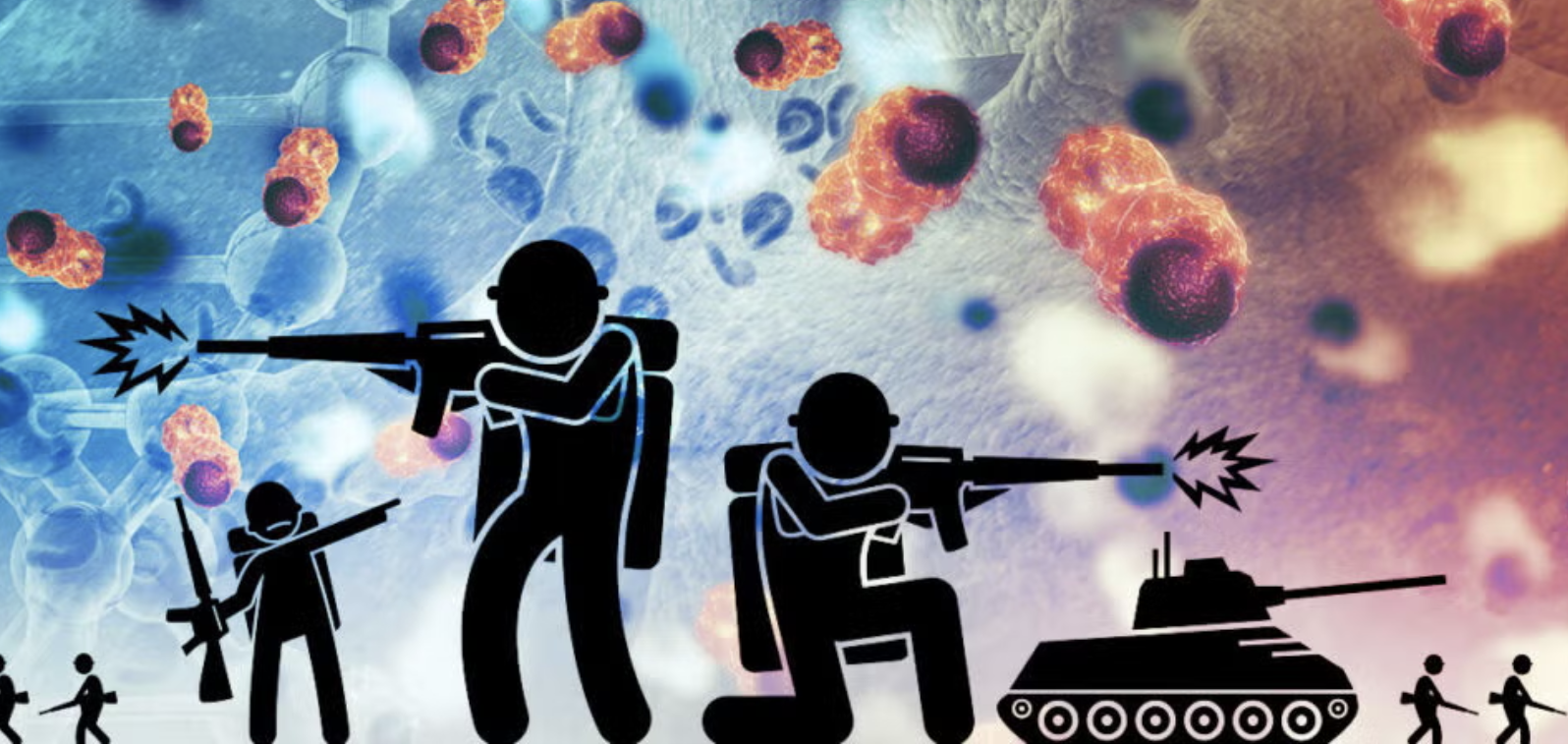
Composite: Dennis Lan. Image source: iStock.
The day after US missiles began raining terror on Iran I flew to California from my home in Massachusetts to sit with a friend undergoing cancer treatment.
It’s my first time caring for a friend with cancer. It was not my first time moving through airports while across the globe it appeared that World War 3 was breaking out. Since the Russian invasion of Ukraine, the Israeli genocide in Gaza, and the U.S. strikes in Iran, Venezuela, Nigeria, and anywhere else they see fit to bomb, it has felt very much like World War 3 is knocking at the door. It is reasonable to expect that the rest of my life – the rest of all of our lives – will be a time of unceasing war somewhere, maybe everywhere. In a world that only grows more toxic, not less, it is also reasonable to expect that cancer will be in our midst, forever.
J., in his late 50’s, is the first friend my age with a cancer diagnosis, but he won’t be the last. A fast-growing tumor on his bladder had him crippled with pain for months. It was removed last week – the whole bladder, not just the tumor – and replaced with a “neo-bladder” constructed from his small intestine. It’s amazing what medical technology can do these days, if you’re insured.
When I told J. I was going to fly to California to sit with him for a week, he asked me to bring my guitar. In his honor I quickly taught myself to play Bella Ciao, an old Italian anti-fascist hymn that European leftists still sing. I played it for him today and it had the intended effect. It helped bring us both to tears.
The body’s effort to grapple with cancer is often portrayed using war metaphors. We say, she is battling with cancer; the cancer is attacking his lymph system; we are bombarding their tumor with radiation. Susan Sontag wrote about this in her 1978 book, Illness as Metaphor as she was undergoing treatment for breast cancer herself. Using military terminology in medical language, she wrote, distorts the reality of disease, making it harder to treat. It makes the disease into something it’s not – an alien enemy to be conquered on the battlefield. She went so far as to call the metaphorical language unscientific – which of course it is, but because military technology and medical technology spring from the same scientific ground, we might not see it that way. The metaphor of cancer as war, Sontag argued, is stigmatizing and disempowering. It implies that when a patient “loses their battle with cancer,” they somehow didn’t fight hard enough. It says they’re weak. It blames the victim.
As my friend J. sleeps in a patch of sun I scroll through the news, sickened as usual, but fascinated. In a mirror world where war is peace and ignorance is strength, the news is increasingly fake – literally fake, AI videos of missiles falling on Tel Aviv and tsunamis engulfing Japan and ICE agents being shot at by trans kids. As all conspiracies are built on a grain of truth, the fact that all of these things are conceivable is what makes them believable. But, while an increasing portion of what passes as news is outright fiction, deep fakes and bot-borne unreality, the stories have no less power over us. Indeed, if I can be dramatic about it, I’d say they drive us increasingly mad.
A prime story in these times is the story that victims are always to blame for their own suffering. The Iranians ‘had it coming to them’ for shouting Death to America, or, just for being Iranian. (One MAGA Ideologue said the 156 girls who died when their school was bombed are better off dead than in a Burqa.) The people of Gaza are reaping the reward for supporting Hamas. The snowflakes of the radical left should shut up about Medicaid and Medicare because Trump is making America great again. The child-rape victims of Epstein and Trump suffer the same stigma as rape-survivors always do: they are young women, what do you expect?
These are all cynical, self-serving, power-reinforcing acts of propaganda. But they serve their purpose. They make us all victims of moral hazard: the feeling that our very powerlessness makes us complicit. We are forced to watch, and to see ourselves in the story, largely helpless, and therefore somehow responsible.
Today in Oakland California its 67 degrees and sunny. I soak up the sun on the porch overlooking San Francisco Bay as J. sleeps. Back in Massachusetts today, my kids’ school was canceled due to snow. Such a simple fact of geography sometimes stuns me – how to hold two truths in the mind at once? As I flew across the continent a few days ago, with slight delays due to the weather, thousands of my fellow Americans were stranded across the Middle East because the Trump administration failed to consider them before it started its bombing campaign. It seems likely many will be stranded within the range of ballistic missiles for weeks, or months. “Some people will die,” Trump said. “That’s what happens in war.”
Today brigades of Kurds are purportedly crossing the border from Turkey into Iran with CIA-supplied weapons, launching a land war, while thousands of Iranians are traveling the other way as refugees crossing into Turkey to escape the bombing. Beirut is under siege, and in the West Bank settlers murder half a dozen Palestinians every day. Here, I feed J. a broth of oxtail and beet greens and we talk about our money problems. California poppies are blooming in wild patches across the hillsides.
Rebecca Solnit, one of the voices of deep sanity at this time, spoke to the New York Times this week addressing the notion that we need an individual hero to lead us out of chaos. Certainly we need principled political voices with strong values and clear visions – a Zohran Mamdani or an Alexandria Ocasio Cortez. But Solnit makes the point that, while “a lot of the left wants social change to look like the French Revolution or Che Guevara,” – a sudden and sustained uprising of righteous crowds behind charismatic leaders hauling billionaires to the guillotine – we may be looking for the wrong signals. “Maybe changing the world is more like caregiving than it is like war,” she writes.
Caregiving is profound work. It is quiet, unheroic, unpaid and mostly done by women with no fanfare, celebration or support. For me, this week, caregiving has looked like cleaning the refrigerator, cleaning the toilet, changing the cat litter, driving to the hospital, administering the meds, stirring the soup. Sometimes it is sitting quietly by the bed while my friend sleeps. I find peace in these acts. And I’m surprised to remember that I’ve done quite a lot of it. For my father who died slowly of emphysema, and my mother who followed him ten years later after a long decline from alcohol-induced dementia. For my wife who lost half the blood in her body after delivering our first child. For my children. And now, as I age, I learn to do it for my friends who will face the inevitable cancers.
You’ve probably done your share of caregiving, too. And we’re all, know it or not, accompanying the collapse of systems far bigger than just our friends and families.
In her book, Hospicing Modernity: Facing Humanity’s Wrongs and the Implications for Social Activism, Vanessa Machado de Oliveira builds out the extended metaphor of social change work as a form of palliative care to the worlds dying within and around us. “Modernity’s desires to conquer and engineer the world on its terms have given us remarkable gifts,” she writes, “while also causing unimaginable suffering and destruction.” Those of us who benefit from its gifts – comfort, convenience, entertainment – find it difficult to let go of the world that is dying. And yet the death of industrial modernity may be the only hope for the life of the biosphere.
One of the truisms I hang onto these days is Antonio Gramsci’s quote, “The old world is dying, and the new world struggles to be born. Now is the time of monsters.”
Doomscrolling through the media I can’t tell what’s true and what’s not. I can only see monsters everywhere. Did Iranian missiles do incalculable damage to US military bases across the Middle East? Are missiles breaking through Israel’s Iron Dome and hitting Jerusalem and Tel Aviv? Is China sending ships to the Persian Gulf? Who are the monsters, and who are the victims, and who are the heroes – and where do I sit in relation to them?
Two things I know to be true today. With MAGA thugs killing people in the streets and filling concentrations camps while US military bases are blown up across the Middle East; with the old order of NATO imploding and Europe dumping its dollars, the US-American empire is collapsing. The collapse will take decades, and many, many lives. Countless, numberless lives. This is one way we know that the collapse is in full swing.
The other thing I know to be true today is that a cancer is in the body of my friend, and my task is to sit with him and make him laugh. Soon I’ll put the sheets in the wash and stir the soup. When J. wakes up maybe we’ll sing another round of Bella Ciao – Goodbye, Beautiful – and we’ll double up on its rousing chorus: bella ciao, bella ciao, bella ciao ciao ciao.
 The Watering Hole :: Jeff Conant
This is really beautiful.
LikeLike